
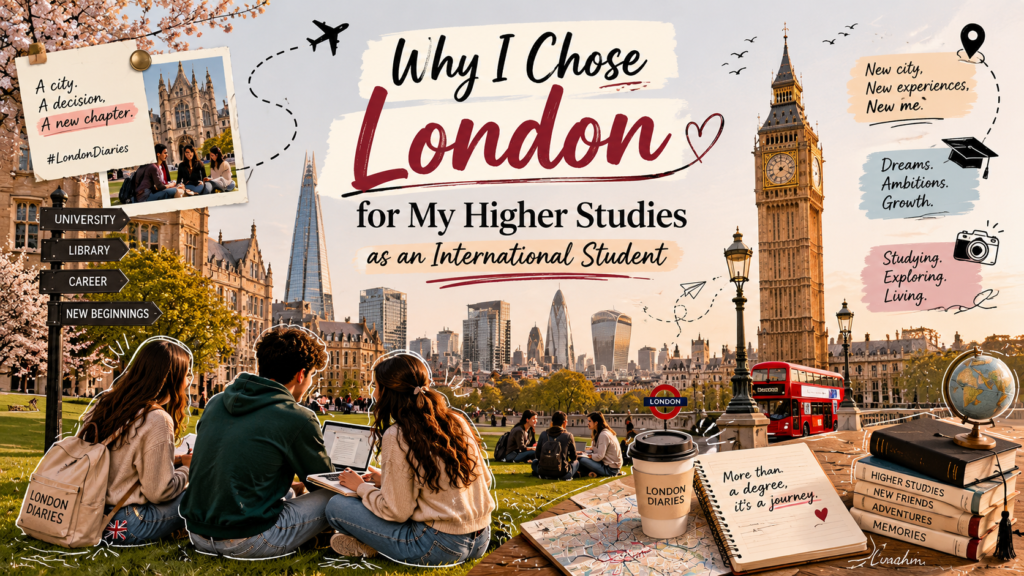
Why I Chose London for My Higher Studies as an International Student
Choosing to study in London as an international student is one of the biggest decisions you will make and one of the most life-changing ones, too. I know it because I made it myself, moving from Mumbai (India) with nothing but a university offer letter and a lot of questions.
I still remember sitting on my bed late at night, multiple tabs open with university websites, Reddit threads about student life in London, tuition fee calculators, and YouTube vlogs from students already living here.
At some point, I stopped asking:
“Can I afford London?”
And started asking:
“What happens if I don’t take this opportunity?”
That shift changed everything. In this blog, I share my honest experience of studying in London, why I chose it over the US, Canada, and Australia, what student life is genuinely like, the real costs involved, and the career advantages that made the decision feel worth it. I’ve also updated this post for 2026 to reflect the latest UK student visa and ranking changes, because the picture has shifted since I first arrived.
Key takeaways
- London ranks 3rd in the QS Best Student Cities 2026 (behind Seoul and Tokyo), after six years at number one, it slipped mainly due to affordability.
- Most UK master’s degrees take one year, saving roughly £12,000–£18,000 versus two-year programmes abroad.
- A realistic monthly student budget in London is around £1,100–£2,000.
- International students can usually work 20 hours per week during term time.
- The Graduate Route post-study visa drops from 2 years to 18 months for applications from 1 January 2027 (PhDs keep 3 years).
Table of Contents
- Why Study in London as an International Student?
- World-Class Universities in London
- The One-Year Master’s Advantage
- Student Life in London: What It’s Really Like
- The Indian Community in London
- Career Opportunities in London for International Students
- The UK Graduate Route Visa (Updated for 2027)
- The Real Cost of Living in London as a Student
- What Nobody Tells You: Expectations vs Reality
- Challenges Every International Student Should Prepare For
- Is Studying in London Worth It?
- FAQs
Why Study in London as an International Student?
London is one of the most popular destinations for international students, and the reasons go beyond prestige. According to the QS Best Student Cities 2026 ranking, London ranks third in the world behind Seoul and Tokyo. After holding the number one spot for six straight years, it slipped, mainly because of a steep drop in the affordability score.
I won’t pretend that isn’t telling (I’m honest about the cost further down). But it’s worth knowing what didn’t change: London still scores at the very top for university quality, employer activity, and the diversity of its student community. The city got more expensive, not less excellent.
Before deciding, I compared four study-abroad destinations seriously:
United States: Excellent universities, but high tuition fees ($40,000–$70,000/year) and growing uncertainty about long-term work sponsorship made the risk seem disproportionate.
Canada: More affordable and stable, but the industries and international exposure I was looking for aligned more strongly with London.
Australia: Appealing lifestyle, but the geographic distance from both India and Europe felt like a significant trade-off.
London: The right balance of education quality, career access, cultural familiarity, and lifestyle. Once I mapped my goals against each city, London came out clearly ahead.
Related: UK’s best student cities | UK vs Canada for Indian students
World-Class Universities in London
One of the strongest reasons to study in London is the concentration of globally ranked institutions in a single city. London is home to:
- University College London (UCL) – consistently inside the global top 10 (QS World University Rankings)
- Imperial College London – ranked among the very top universities in the world (QS World University Rankings)
- King’s College London – a global top-40 university
- London School of Economics (LSE) – among the top globally for social sciences
I personally chose Brunel University London because the course structure aligned closely with my career goals and offered a practical, industry-facing learning environment.
What genuinely sets London universities apart is the teaching approach. Rather than memorising content, students are pushed toward:
- critical analysis and independent research
- group presentations and collaborative projects
- real-world case studies and applied problem-solving
For international students, this builds professional confidence quickly, with skills that transfer directly into the UK job market.
The One-Year Master’s Advantage
A major practical reason why so many international students choose the UK for postgraduate study is the one-year master’s structure.
While master’s degrees in the US, Canada, and Australia typically take two years, most UK programmes are completed in 12 months. This creates real financial and career advantages:
- Lower total tuition spend as you pay one year of fees, not two
- Reduced living costs, roughly £12,000–£18,000 saved on accommodation and expenses
- Faster market entry, where you are job-ready 12 months sooner than peers abroad
- Quicker return on investment, where your earning window opens a year earlier
Yes, the pace is intense. But for most students, the compressed timeline is worth it, and with the post-study visa window getting shorter from 2027 (more on that below), getting job-ready quickly matters more than ever.
Related: one-year-vs-two-year-masters
Student Life in London: What It’s Really Like

Student life in London is exciting, culturally rich, and genuinely diverse, but it also demands more independence than most students expect.
Every neighbourhood has its own personality. Shoreditch feels creative and energetic. Notting Hill is calmer and residential. Canary Wharf is corporate and polished. Uxbridge, where I live, is quiet and peaceful. Part of what makes living here interesting is that you find your own corner of the city.
Most students opt for university accommodation, which helps them build connections early. (If you’re weighing up halls versus private renting, I’ve written a full guide on how I found student accommodation in London.)
On any given week, there is access to:
- cultural festivals, food markets, and pop-up events
- free world-class museums (the British Museum, V&A, Natural History Museum, and more)
- student society events across every interest
- networking evenings hosted by companies and universities
- affordable theatre and live music through student discounts
But student life in London also teaches you how to manage yourself. Time, money, social energy, and academic pressure all compete. Nobody organises your calendar for you. That independence seems challenging at first, but it is genuinely one of the most valuable things the city gives you.
The Indian Community in London
For Indian students, especially, London’s large and established South Asian community makes the early adjustment period significantly easier.
Areas like Southall, Wembley, and Harrow have Indian grocery stores, restaurants, temples, and familiar languages on the street. During the first few weeks, when homesickness is at its sharpest, this cultural familiarity matters more than people expect.
Over time, the Indian community in London becomes something more than comfort. It becomes:
- a professional network with strong representation in finance, tech, law, and consulting
- a source of practical guidance from people who have navigated the same transition
- a social circle that understands the specific experience of being far from home
For many students, this community is the difference between surviving the first few months and genuinely thriving.
Career Opportunities in London for International Students
Career access was one of the deciding factors in my choice to study in London.
London is one of the world’s largest financial and business hubs, home to the European or global headquarters of companies including Google, Meta, Goldman Sachs, Deloitte, and HSBC. The industries hiring actively include:
- financial services and fintech
- technology and product
- media, advertising, and marketing
- consulting and strategy
- fashion, retail, and e-commerce
For international students, the city offers a concentrated professional ecosystem that smaller UK cities and most global alternatives simply cannot match. Opportunities include:
- Part-time work during studies, where most student visa holders can work up to 20 hours per week during term time (here’s my honest guide to part-time jobs in London)
- Internships and placements, with many London universities offering strong employer partnerships
- Graduate schemes in large firms that run annual graduate intakes specifically targeting London university graduates
- Networking events, with industry meetups, alumni events, and sector-specific panels running throughout the year
According to UK graduate labour market statistics, graduate employment rates in London consistently outperform the UK national average, a useful signal of the city’s job market depth.
The UK Graduate Route Visa (Updated for 2027)
The UK Graduate Route visa played a significant role in my decision-making process, and it should factor into yours too, but the rules are changing, so read this carefully.
This route allows eligible international students to remain in the UK after graduating and work (or look for work) without requiring immediate employer sponsorship.
Here is the current picture:
- Right now, undergraduate and master’s graduates can stay for 2 years, and PhD graduates for 3 years.
- From 1 January 2027, the post-study stay for bachelor’s and master’s graduates drops to 18 months. PhD graduates keep their 3 years.
This change was confirmed in the Statement of Changes in Immigration Rules published in October 2025, following the government’s 2025 immigration white paper. The key thing to understand is that what matters is when you apply for the Graduate Route, not when you start studying, so most people starting degrees in 2026 should plan around the 18-month window.
A few other current changes worth knowing: the minimum English requirement rose to B2 in 2026, only PhD and research students can now bring dependants, and an international student levy is due to start in 2028. I’ve broken all of this down, plus exactly who’s affected, in What the 2027 UK Graduate Route Changes Mean for International Students.
Always confirm the latest position on the UK Visas and Immigration Graduate Route page before making decisions, as immigration rules continue to evolve.
The Real Cost of Living in London as a Student
There is no point softening this: London is expensive. It consistently ranks among the most costly cities in Europe for accommodation and daily living — and as I mentioned earlier, affordability is the single reason it slipped from first to third in the QS student cities ranking.
A realistic monthly student budget sits somewhere between roughly £1,100 and £2,000, depending heavily on your accommodation, travel habits, and lifestyle. Rent is by far the biggest line — I break the full picture down in my student accommodation guide. (For the latest daily-cost figures, Numbeo’s London cost of living data is a good live reference.)
Managing finances well becomes a genuine skill. Most students learn to cook at home, use student discount programmes like TOTUM, and rely on the tube rather than taxis. The discipline you build around money in London is one of the most useful things you will take with you.
That said, with careful planning, the cost is manageable. And for many students, the opportunities London provides make the financial stretch worthwhile.
What Nobody Tells You: Expectations vs Reality
Expectation: London will feel exciting all the time
Reality: Some days are genuinely hard. Cold, expensive, and lonely, especially in January and February when the novelty has worn off and the workload is peaking.
This is normal. It passes. And the resilience you build through it is real.
Expectation: Career opportunities will come naturally
Reality: You have to chase them. Networking in London is active, not passive. Attending events, reaching out on LinkedIn, and visiting career fairs are specifically the things the city rewards. With a shorter post-study window coming in 2027, starting early matters even more.
Expectation: The Indian community will feel like home immediately
Reality: It takes time to find your people. But once you do, the connections tend to be deep and lasting.
Challenges Every International Student Should Prepare For
Homesickness: The first two to three months are genuinely the hardest. Staying connected with family while building a new social circle here takes conscious effort.
Weather: The grey skies and short winter days affect mood more than most people anticipate. A SAD lamp and regular outdoor time during daylight hours make a real difference.
The pace: London moves fast. Commutes are long. People are busy. Adapting to the rhythm takes time but eventually becomes second nature.
Financial pressure: Tuition fees plus living costs add up quickly. Having a realistic financial plan before you arrive isn’t just helpful, it’s essential.
Is Studying in London Worth It?
For me, yes, without giving it a second thought.
Studying in London gave me academic growth, industry exposure, genuine independence, and a perspective on the world that I could not have built anywhere else. The city challenged me in ways I did not expect and gave me far more than a degree.
But the honest answer is that the value depends on what you want from the experience. If you are looking for a world-class education, career access, and genuine life experience all in one place, then London delivers all three — as long as you go in with clear eyes about the cost and the changing visa rules.
Start Planning Your London Journey
If you are currently deciding whether to study in London as an international student, the most useful thing I can tell you is this: research carefully, plan your finances realistically, understand the latest visa rules, and choose the city that excites you as much personally as it does academically.
Read next on London Diaries:
- How I Found Student Accommodation in London: A Complete Guide
- Part-Time Jobs in London for International Students: What You Need to Know
- What the 2027 UK Graduate Route Changes Mean for International Students
Is London good for international students?
Is studying in London expensive?
Can international students work while studying in London?
What is student life like in London?
What is the UK Graduate Route visa?
Is studying in London worth it?
By Samruddhi Dawkhar